Transfer Pricing Risks of Interest-Free Loans Between Related
Parties in Malaysia
Published: 15 Apr 2026
Providing financial assistance within related parties is a common business practice. It is quite common for holding companies to provide loans or advances to related entities to support business operations or expansion.
But here’s the key question:
👉 Can a company really
give an interest-free loan without any tax consequences?
From a transfer pricing perspective, such arrangements may attract scrutiny from the tax authority under Section 140A of the Income Tax Act 1967.
Let’s look at a real tax audit scenario to understand how this works in practice.
Background of the Case
(This article is prepared for illustrative purposes only. The facts have been generalised and anonymised to preserve confidentiality. All client information is treated as Private & Confidential (P&C) in accordance with professional standards.)
In this case, a taxpayer (a holding company) provided significant advances and loans on an interest-free basis to another company outside its corporate group. The accounts reflected interest-free loans and advances of approximately RM29 million from YA 2020 to YA 2024.
The borrower company was owned by a common director who was considered to have control or influence over both entities. The taxpayer was not aware that the loans or advances granted to the borrower company were required to comply with the arm’s length principle (i.e. market interest rate).
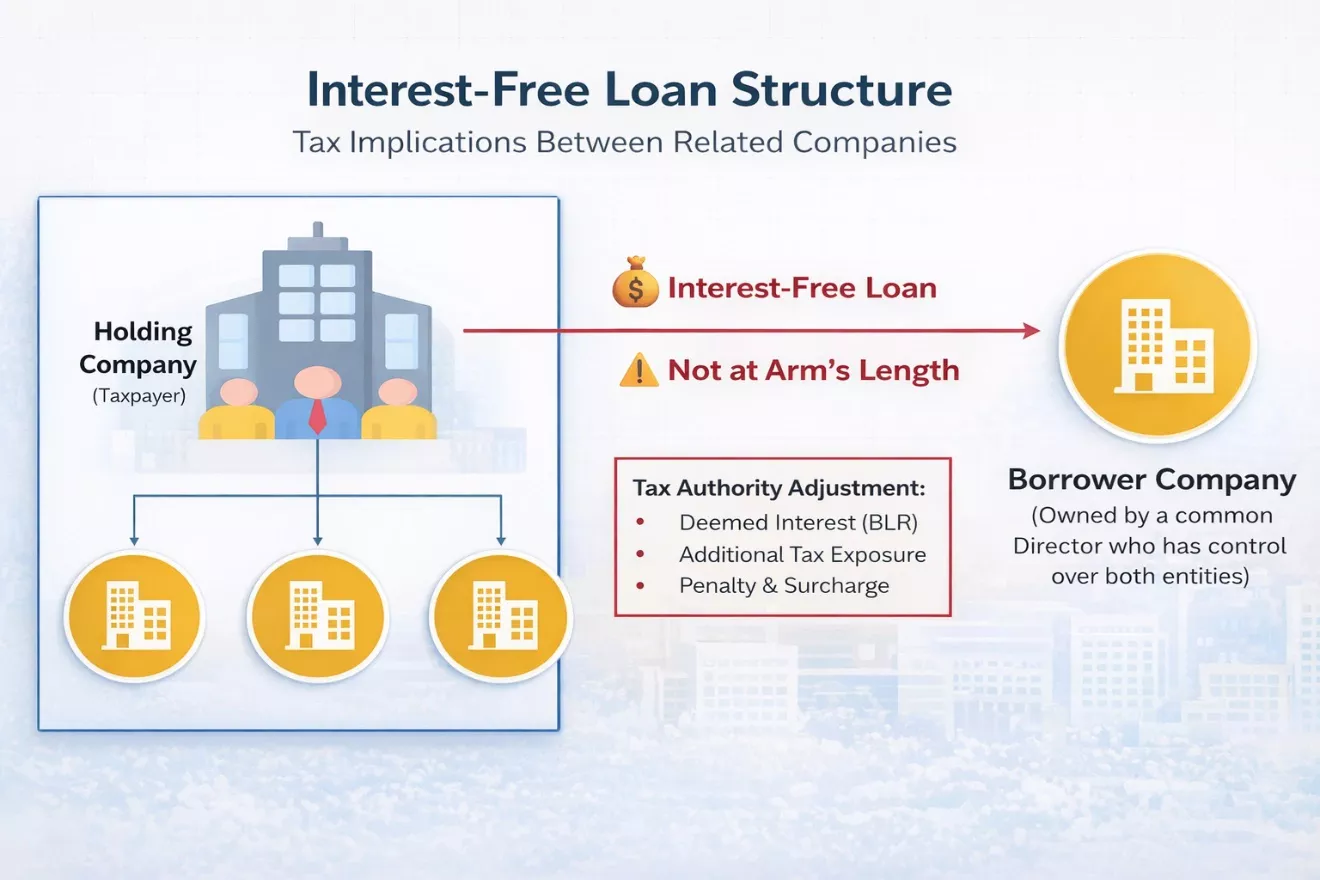
Following a tax audit covering YA 2020 to YA 2024, the tax authority treated the arrangement as a related-party transaction for transfer pricing purposes and took the view that:
👉 The interest-free loan did not reflect an arm’s length transaction.
As a result, the tax authority imposed deemed interest income based on the Base Lending Rate (BLR).
This led to:
- an estimated understatement of interest income of approximately RM7.7 million, and
- additional tax payable of approximately RM1.85 million.
under Section 140A of the Income Tax Act 1967.
Example:
If a company lends RM10 million interest-free loan, and the market rate is 5%, the tax authority may treat this as if RM500,000 interest income was earned each year.
At a 24% tax rate, this could result in an additional tax payable of approximately RM120,000 annually.
What Does the Law Say?
Under Section 140A of the Income Tax Act 1967, the tax authority has the power to adjust related-party transactions to ensure they reflect arm’s length conditions.
Seksyen 140A menyatakan:
"Ketua Pengarah boleh, jika dia berpuas hati bahawa, kerana apa-apa transaksi atau siri transaksi di antara orang yang bersekutu, bahawa jumlah pendapatan bagi mana-mana orang yang bersekutu tidak sepadan dengan apa yang akan terakru kepada orang itu jika transaksi atau siri transaksi itu adalah berprinsip arm's length,
...dia boleh, tanpa menjejaskan apa-apa liabiliti sedemikian... mengabaikan transaksi atau siri transaksi itu atau membuat pelarasan yang perlu kepada pendapatan mana-mana orang yang bersekutu itu."
In simple terms:
👉 If independent parties
would have charged interest,
👉
the tax authority may impose a market-based interest rate.
Why Did the Tax Authority
Impose Deemed Interest?
So, why did the tax authority take this position? Here are the key reasons:
1. Not an Arm’s Length Transaction
Providing large amounts of financing without any interest, especially over several years (YA 2020–YA 2024), is generally not considered commercially realistic.
In the real world:
👉 Banks and independent lenders always charge interest.
2. Reduction of Taxable Income
By not charging interest, the company effectively reduced its taxable income.
Interest income that would normally be taxable under Section 4(c) of the Income Tax Act 1967 was not reported.
From the tax authority’s
perspective:
👉
This resulted in less tax being paid than it should have been.
3. Related-Party Arrangement
The loan involved parties connected through a common director, who was considered by the tax authority to have control or influence over both companies.
Because of this relationship:
👉 The transaction must follow the arm’s length principle.
Failing which, the tax authority has the power to make adjustments under Section 140A.
Penalties and Surcharges
The impact does not stop at adjustments. The tax authority also imposed:
- a penalty under Section 113(2) of the Income Tax Act 1967, charged on the additional tax payable; and
- a surcharge under Section 140A(3C) of the Income Tax Act 1967, charged on the transfer pricing adjustments.
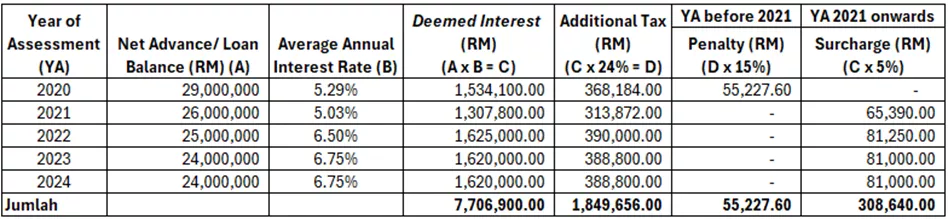
👉 This significantly increases the total tax exposure, with total additional liabilities (tax plus penalty and surcharge) amounting to RM2,213,523.60.
Key Takeaway
Yes — companies can give interest-free loans.
But from a transfer pricing
perspective:
👉 It is unlikely that an
independent party would lend money for free.
As the saying goes:
“There is no free lunch.”
The tax authority expects related-party financing to reflect market-based interest rates under Section 140A.
Practical Tip
Before providing interest-free loans, consider:
- Is there a commercial justification?
- Would an independent party do the same?
- Do you have documentation to support your position?
Proper planning and documentation can help reduce exposure during a tax audit.
Need Professional Advice?
If you are facing a similar tax audit issue or would like to review your intercompany financing arrangements, feel free to reach out to us via WhatsApp.
Frequently Asked Questions
(FAQ)
1. Can a company give an interest-free loan
in Malaysia?
Yes, there is no law that prohibits companies from providing interest-free loans. However, from a transfer pricing perspective under Section 140A of the Income Tax Act 1967, the tax authority may assess whether the transaction complies with the arm’s length principle.
2. Will the tax authority always impose
deemed interest?
Not necessarily. The tax authority will assess the facts and circumstances of each case, including:
- relationship between the parties
- commercial justification
- availability of supporting documentation
However, in many cases, interest-free loans between related parties are commonly scrutinised.
3. How can companies defend interest-free
loans?
Companies should prepare:
- transfer pricing documentation
- justification for commercial rationale
- supporting evidence showing why no interest was charged