Service
Tax on Rental or Leasing Services Malaysia: How Is the RM1 Million Threshold
Determined for Joint Property Owners?
Publish: 18 September 2026
If a property is jointly owned by several individuals or entities, should their rental income be combined when determining the RM1 million service tax registration threshold?
This is a common question following the expansion of service tax to rental or leasing services from 1 July 2025.
The answer depends on how the rental or leasing arrangement is structured and, importantly, how the rental is invoiced.
Under Group K of the First Schedule to the Service Tax Regulations 2018, rental or leasing services of tangible assets are taxable services, subject to the applicable exclusions and exemptions. The prescribed registration threshold for rental or leasing services is RM1 million.
The Royal Malaysian Customs Department (RMCD) has now provided further clarification through Service Tax Policy No. 4/2026 dated 22 July 2026, which specifically addresses rental or leasing services provided by more than one service provider.
Is
rental income from property subject to service tax?
Not all rental income is subject to service tax.
If you are renting out housing accommodation, such as a residential property, the rental is not subject to service tax under Group K.
According to the RMCD's Guide on Rental or Leasing Services dated 14 May 2026, housing accommodation refers to a residential building as described in the grant title. This includes, among others, SOHO, service apartment, service condominium, service suite and residential suits.

Therefore, landlords should first determine whether the property falls within the definition of housing accommodation before considering the service tax implications.
For example, rental of a property that is genuinely housing accommodation would generally fall outside the taxable rental or leasing service.
On the other hand, rental or leasing of non-residential property, such as commercial property, may fall within the scope of Group K and may be subject to service tax, subject to the applicable exemptions and rules.
What
happens if a property is jointly owned?
This is where things can become confusing.
This issue has been specifically addressed by Service Tax Policy No. 4/2026.
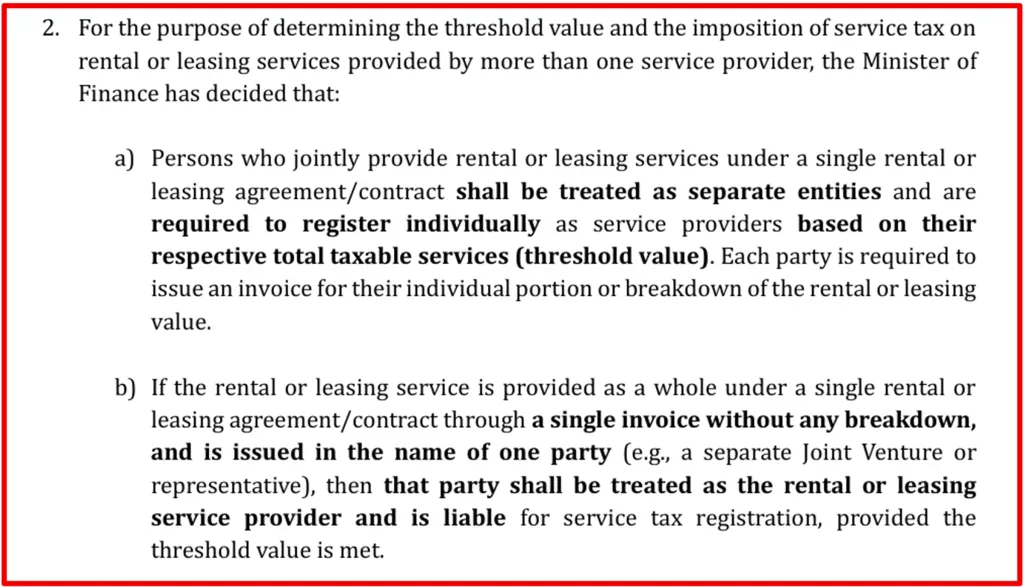
Source: Service Tax Policy No. 4/2026 dated 22 July 2026 - Determination of Threshold Value and Imposition of Service Tax on Rental or Leasing Services, Group K, First Schedule, Service Tax Regulations 2018 Provided By More Than One Service Provider
The policy provides different treatments depending on how the rental or leasing service is provided and invoiced.
Scenario
1: Multiple Parties Jointly Provide Rental or Leasing Services Under Single
Agreement
Where two or more persons jointly provide rental or leasing services under a single rental or leasing agreement or contract, the parties are treated as separate entities for determining their service tax registration obligations.
Each party is required to determine whether the value of its own total taxable services has exceeded the prescribed registration threshold.
Each party should also issue an invoice for its respective portion or breakdown of the rental or leasing value.
How
does this work?
For example, assume Individual A, Individual B and Individual C jointly provide rental services under one tenancy agreement.
The property is rented to a tenant at RM1,200,000 for a 12-month rental period.
The rental is divided equally among the three parties:
| Service provider | Individual portion |
|---|---|
| Individual A | RM400,000 |
| Individual B | RM400,000 |
| Individual C | RM400,000 |
| Total | RM1,200,000 |
Under this treatment, the parties are not combined as one service provider merely because they are parties to the same agreement.
Instead:
- Individual A considers its own taxable rental or leasing services;
- Individual B considers its own taxable rental or leasing services; and
- Individual C considers its own taxable rental or leasing services.
If a particular party reaches the applicable registration threshold of RM 1million, that party is required to register for service tax.
Separate
invoices are important
Another important requirement is the invoicing arrangement.
Each party is required to issue an invoice for its own portion or breakdown of the rental or leasing value.
In other words, the rental value should be identifiable according to the respective portion provided by each service provider.
For example:
Total rental value: RM1,200,000
| Service provider | Individual portion |
|---|---|
| Individual A | RM400,000 |
| Individual B | RM400,000 |
| Individual C | RM400,000 |
| Total | RM1,200,000 |
In this case, each individual would take into account RM400,000 as their portion of the rental when determining whether they have exceeded the RM1 million service tax registration threshold.
The total rental of RM1,200,000 is therefore not automatically treated as RM1,200,000 of taxable services for each individual.
Based on this example, none of the three individuals would be required to register for service tax based on this rental income alone, as each individual's rental portion is below the RM1 million registration threshold.
However, if any individual has other taxable rental or leasing income, that individual would need to consider the total value of their taxable services when determining whether the RM1 million registration threshold has been exceeded.
In short, for this scenario, it is important to look at the rental value attributable to each service provider, rather than simply the total rental collected from the tenant.
Scenario
2: One Party Issues a Single Invoice for the Entire Rental or Leasing
Service
The treatment is different where the rental or leasing service is provided as a whole under a single agreement or contract.
In this situation, the service is provided through one single invoice without any breakdown, and the invoice is issued in the name of one party.
In this case, the party named on the invoice is treated as the rental or leasing service provider for service tax purposes. If the applicable registration threshold is met, that party is responsible for service tax registration.
Example
Assume Individual A, Individual B and Individual C jointly arrange a rental service.
The property is rented to a tenant at RM1.2 million for a 12-month rental period.
However, instead of each party issuing an invoice for its respective portion, Individual A issues one invoice for the full RM1.2 million to the tenant.
In this situation, the Individual A is treated as the service provider for service tax purposes.
Accordingly, Individual A would need to consider the full RM1.2 million when determining whether the registration threshold has been exceeded.
What
Should Property Owners Do?
If you jointly own or jointly rent out a commercial or other non-residential property, it is worthwhile to review your arrangement carefully.
Consider the following questions:
1.
What type of property is being rented?
First determine whether the property is housing accommodation or falls within the taxable scope of rental or leasing services.
2.
Who are the parties providing the rental service?
Identify all persons involved in providing the rental or leasing service.
3.
What does the rental agreement say?
Review whether the agreement identifies multiple parties as the service providers or designates one party to provide the rental service.
4.
Who issues the invoice?
Determine whether:
- each party issues an invoice for its respective portion; or
- one party issues a single invoice for the entire rental amount.
5.
Has the RM1 million registration threshold been exceeded?
Each relevant service provider should assess its own taxable services based on the applicable service tax rules and scenarios.
Need
help with your rental or leasing service tax treatment?
If you have a jointly owned property, commercial property or other rental arrangement and would like to understand how Service Tax Policy No. 4/2026 applies to your situation, feel free to reach out to us via WhatsApp.
This article is intended for general information purposes only and should be read together with the Service Tax Act 2018, Service Tax Regulations 2018, applicable subsidiary legislation, and the latest guidance and policies issued by the Royal Malaysian Customs Department. The service tax treatment may depend on the specific contractual, ownership and invoicing arrangements.