Malaysia Tax Guide for Expatriates: What Foreign
Employees and Employers Need to Know
Publish: 06 November 2026
Malaysia continues to attract foreign professionals and expatriates seeking employment opportunities across various industries. While working in Malaysia offers career and business opportunities, understanding the country's income tax requirements is equally important for both foreign employees and their employers.
Unlike some countries where tax obligations are determined primarily by nationality, Malaysia generally determines an individual's income tax treatment based on their tax residency status and the source of their income.
Whether you are an expatriate working in Malaysia or an employer hiring foreign professionals, understanding the applicable tax rates, monthly tax deductions, annual filing requirements and tax clearance procedures can help prevent unnecessary tax complications.
This guide highlights the key Malaysian income tax considerations that both foreign employees and employers should understand.
1. Understanding Malaysian Income Tax for Expatriates
1.1 Tax Residency: Resident vs Non-Resident
One of the most important considerations for expatriates working in Malaysia is determining their tax residency status.
Under Section 7 of the Income Tax Act 1967 (ITA), an individual's tax residency is generally determined based on their physical presence in Malaysia during the relevant calendar year, together with other qualifying conditions.
The commonly referred to 182-day rule provides that an individual may qualify as a Malaysian tax resident if they are physically present in Malaysia for 182 days or more during the basis year.
However, tax residency is not determined solely by the 182-day rule. Section 7 also provides other alternative tests, including certain linked-year and 90-day conditions.
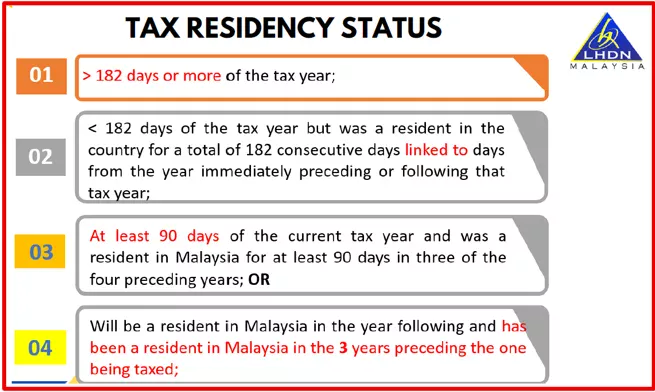
Source: LHDN, Tax Education Division, Tax & Expatriates Presentation (12 March 2024), Tax Residency Status under Section 7 of the Income Tax Act 1967.
Importantly, tax residency is assessed annually. An expatriate who qualifies as a tax resident in one year does not automatically retain the same status in subsequent years.
What is the difference between a tax resident and a
non-resident?
| Particulars | Tax Resident | Non-Resident |
|---|---|---|
| Employment income tax rate | Progressive tax rates (0%–30%) | Generally 30% |
| Personal tax reliefs | Eligible, subject to conditions | Not eligible |
| Tax rebates | Eligible, subject to conditions | Not eligible |
| Individual tax return | Form BE, if employment income only | Form M |
Therefore, an expatriate should not assume that the 30% non-resident tax rate automatically applies simply because they are a foreign national.
1.2 The 60-Day Employment Exemption
Not all foreign employees working in Malaysia are necessarily subject to Malaysian income tax.
Under Paragraph 21 of Schedule 6 of the ITA, employment income may be exempt from Malaysian income tax where the relevant employment in Malaysia does not exceed 60 days in aggregate during the basis year, subject to the statutory conditions.
This exemption may be relevant to foreign professionals who travel to Malaysia for short-term assignments, temporary projects, training or business-related activities.
However, the exemption is subject to specific conditions and exceptions, including certain employment periods spanning two consecutive basis years. Therefore, employers should assess the circumstances before treating the employment income as tax-exempt.
1.3 Taxation of Malaysian-Sourced and Foreign-Sourced
Income
Generally, employment income derived from exercising employment in Malaysia is subject to Malaysian income tax, regardless of whether the salary is paid in Malaysia or overseas.
For expatriates, it is also important to distinguish between Malaysian-sourced income and foreign-sourced income.
Malaysia generally operates on a territorial basis for income tax purposes. Foreign-sourced income received in Malaysia may be subject to specific exemption provisions, subject to the applicable conditions and prevailing rules.
Expatriates should also consider the tax laws of their home countries and any applicable Double Taxation Agreement (DTA) to understand whether additional reporting or tax obligations may arise.
2. Tax Matters Every Foreign Employee Should Know
2.1 What Employment Income Is Taxable?
An expatriate's taxable employment income is not limited to basic monthly salary. Depending on the nature of the payment and applicable exemptions, the following may also be subject to Malaysian income tax:
- Salary, wages and bonuses.
- Housing, car and other allowances.
- Benefits-in-kind, such as accommodation and company cars.
- Other employment-related benefits and perquisites.
Certain benefits and allowances may qualify for tax exemptions, subject to prescribed conditions and limits.
Therefore, expatriates should review their employment contracts and remuneration packages to understand the potential tax implications before accepting an employment offer.
2.2 PCB and Annual Tax Filing Obligations
Monthly Tax Deduction (MTD), commonly known as Potongan Cukai Bulanan (PCB), is a mechanism used by employers to deduct income tax from employees' monthly remuneration and remit the deductions to the Inland Revenue Board of Malaysia (LHDN).
The applicable PCB calculation depends on the employee's tax residency status.
Generally:
- Tax residents are subject to PCB calculations based on the prescribed formula, taking into account applicable deductions and relevant information.
- Non-residents, or employees whose residency status is not yet established for PCB purposes, are generally subject to a 30% deduction on their remuneration, subject to applicable exemptions.
In addition to PCB deductions, employees are responsible for submitting their annual income tax returns to LHDN. The applicable tax return form depends on their tax residency status:
- Tax Residents: Generally required to submit Form BE if they derive employment income only.
- Non-Residents: Generally required to submit Form M to declare their Malaysian taxable income.
Employees should also review their Form EA, which is issued by their employer, to ensure that their employment income, benefits and tax deductions are accurately reported.
2.3 Does Returning to Your Home Country Affect Your Tax
Residency?
An expatriate may occasionally return to their home country for an extended holiday, family matters or other personal reasons.
However, leaving Malaysia temporarily does not automatically mean that the individual becomes a non-resident for tax purposes.
For example, an expatriate who has worked in Malaysia for two consecutive years may decide to return to their home country for four months before resuming employment in Malaysia.
In this situation, the employee's tax residency must be reassessed based on the relevant Section 7 tests for the particular Year of Assessment.
One important consideration is the temporary absence provision under Paragraph 7(1)(b). For the linked 182-day test, certain temporary absences may be treated as part of the period in Malaysia, including:
- Absence connected with employment duties in Malaysia, including attending conferences, seminars or study abroad.
- Absence due to illness involving the individual or an immediate family member.
- Social visits outside Malaysia not exceeding 14 days in aggregate.
A normal four-month holiday would not automatically qualify as a temporary absence under these provisions.
Employees should maintain supporting documents such as passport entry and exit records, flight tickets and employer confirmation to substantiate their physical presence (if required) and relevant absences.
3. Employer's Tax Responsibilities When Hiring
Expatriates
Employers hiring foreign professionals should not overlook their tax compliance responsibilities. Apart from deducting PCB, employers are required to fulfil various notification, reporting and tax clearance obligations.
3.1 Employee Notification and Annual Reporting
Employers are generally required to notify LHDN when hiring a new employee who is chargeable or likely to be chargeable to income tax.
The relevant notification is Form CP22, which is generally required to be submitted within 30 days from the commencement of employment, through the prescribed electronic submission channel.
Employers must also ensure that annual reporting obligations are fulfilled, including:
- Form EA: Providing employees with an annual statement of remuneration and tax deductions.
- Form E: Submitting the employer's annual return to LHDN.
- PCB remittance: Deducting and remitting PCB within the prescribed deadlines.
Accurate employee information, including passport details, commencement dates, remuneration and tax residency status, is important to ensure proper tax reporting.
3.2 PCB Calculation and Payroll System Compliance
Many employers outsource payroll processing or use computerised systems to calculate employees' monthly tax deductions. However, outsourcing does not remove the employer's responsibility to ensure that PCB is correctly calculated and remitted.
Employers should ensure that:
- Payroll systems are up to date and comply with the latest PCB calculation specifications.
- Employee information is accurate, including tax residency status, remuneration, allowances and benefits.
- Payroll calculations are reviewed periodically to identify any discrepancies.
LHDN publishes a list of software providers and employers whose computerised PCB calculation systems meet its prescribed specifications. Nevertheless, employers remain responsible for ensuring the accuracy of payroll information and PCB deductions.
3.3 Tax Clearance When an Expatriate Leaves Malaysia
Tax clearance is another important responsibility for employers when an expatriate resigns, retires or leaves Malaysia.
Depending on the circumstances, employers may be required to submit the following notifications:
| Form | Purpose |
|---|---|
| CP21 | Notification when an employee intends to leave Malaysia for a period exceeding three months |
| CP22A | Notification of cessation of employment for private-sector employees |
| CP22B | Notification of cessation of employment for public-sector employees |
Generally, CP21 must be submitted at least 30 days before the employee's expected departure if the employee is chargeable to tax in respect of employment income and intends to leave Malaysia for more than three months.
When Is Form CP22A / CP22B Required?
Employers are generally required to submit Form CP22A (private-sector employees) or CP22B (public-sector employees) when an employee ceases employment due to resignation, retirement or termination, or in the event of the employee's death.
However, certain cases are exempted from the SPC notification requirement. The table below serves as a general guide to help employers determine whether Form CP22A / CP22B needs to be submitted through the e-SPC application on the MyTax Portal.
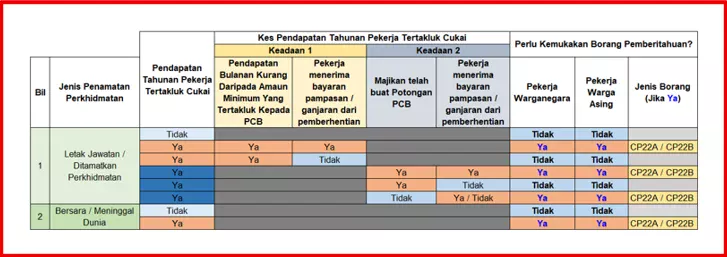
Source: Inland Revenue Board of Malaysia (LHDN) website, Notification of Cessation of Employment, updated 8 September 2026.
Employers may also be required to withhold money payable to the employee pending the issuance of the Tax Clearance Letter (Surat Penyelesaian Cukai), subject to the relevant statutory provisions and exceptions.
Failure to comply with these requirements may expose employers to penalties and potential responsibility for the employee's outstanding tax liabilities.
Therefore, employers should identify potential tax clearance requirements early rather than waiting until the employee's final working day.
4. Frequently Asked Questions (FAQs)
Q1: Is the 30% tax rate automatically applicable to all
foreign employees working in Malaysia?
No. The 30% rate generally applies to non-resident individuals on Malaysian employment income. Foreign employees who qualify as Malaysian tax residents are generally subject to progressive tax rates and may claim eligible personal reliefs.
Q2: Does an expatriate automatically become a tax
resident after working in Malaysia for two years?
No. Tax residency is determined annually based on the tests under Section 7 of the ITA. Working in Malaysia for two years does not automatically guarantee tax residency in subsequent years.
Q3: Must employers deduct 30% tax when employees return
to their home country for two to four months?
Not automatically. Employers should reassess the employee's tax residency status for the relevant Year of Assessment based on the tests under Section 7 of the ITA. The applicable PCB deduction should be based on the employee's circumstances and the prescribed calculation requirements.
Q4: Does LHDN approve payroll software used by employers?
LHDN publishes a list of software providers and employers whose computerised PCB calculation systems meet its prescribed specifications. Employers should check the latest list rather than rely solely on their payroll vendor's assurance.
Q5: Is a RM2,000 cash past achievement award subject to
PCB?
A qualifying past achievement award may enjoy an income tax exemption of up to RM2,000 per Year of Assessment, subject to the prescribed conditions. Where the award qualifies for exemption, the exempt portion should be excluded from taxable remuneration for PCB purposes and reported under Part F of Form EA. Any excess over the exemption limit is generally taxable.
Q6: What happens if an expatriate leaves Malaysia without
completing tax clearance?
Failure to comply with the applicable tax clearance requirements may result in outstanding tax liabilities, penalties and complications in finalising the employee's tax affairs. Employers should identify and fulfil their notification and withholding obligations before the employee's departure.
Conclusion
Managing expatriate taxation involves more than simply deducting monthly tax from an employee's salary. From determining tax residency status and reviewing remuneration packages to ensuring accurate PCB calculations, annual tax reporting and tax clearance, both employees and employers must understand their respective obligations under Malaysian tax law.
For expatriates, proper tax planning and compliance can help prevent unexpected tax liabilities and unnecessary complications when changing employment or leaving Malaysia.
For employers, having the right payroll processes, tax reporting procedures and tax clearance arrangements in place is essential to managing compliance risks.
How YYC
can help
At YYC, our tax professionals provide a range of tax compliance and advisory services to assist foreign employees and Malaysian employers, including:
- Expatriate individual income tax compliance and filing.
- Tax residency assessment and advisory.
- Employer tax compliance and annual reporting.
- Individual and corporate tax advisory services.
Whether you are an expatriate working in Malaysia or an employer managing a foreign workforce, YYC can assist you in navigating Malaysian tax requirements with greater confidence.
Contact YYC today to find out how we can support your expatriate tax compliance and advisory needs.
Disclaimer: This article is intended for general information purposes only and should not be regarded as professional tax advice. The tax treatment of each individual depends on the relevant facts and circumstances, applicable legislation and prevailing LHDN guidelines. Professional advice should be obtained before making tax decisions.