Malaysia Budget 2027: What's Changing for Traders and Manufacturers Under the New Sales Tax Refund Facility?
Publish: 13 November 2026
At a Glance: Proposed Sales Tax Refund Facility
| Key area | Details |
|---|---|
| Proposed effective date | 1 January 2027 |
| Who may claim the proposed refund? | Local traders or distributors who have paid sales tax on qualifying goods supplied to manufacturers |
| Goods covered | Machinery, equipment and spare parts under Item 55, Schedule A, and approved manufacturing inputs under Schedule B |
| Industries covered under Schedule B | Pharmaceutical products, animal feed, fertilisers and pesticides |
| Main objective | To extend sales tax relief to qualifying purchases made through local traders and distributors |
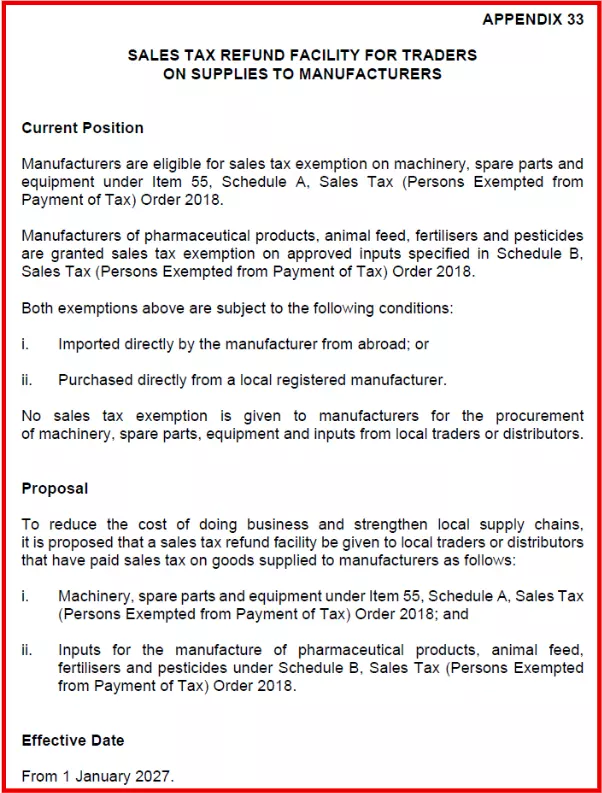
Source: Appendix 33, Tax Measures – Budget 2027, Ministry of Finance Malaysia.
1. Why Is This New Sales Tax Refund Facility Needed?
Imagine a manufacturer purchasing a production machine from a local distributor. Although the machine may qualify for sales tax exemption under Item 55, Schedule A of the Sales Tax (Persons Exempted from Payment of Tax) Order 2018, the manufacturer may still bear sales tax when purchasing through a local trader or distributor.
Why? The existing exemption mechanism is subject to specific purchasing channels and conditions. Under the position described in Appendix 33, the exemption is available where qualifying goods are imported directly by the manufacturer or purchased directly from an eligible local manufacturer. Purchases through local traders or distributors are not covered by the existing arrangement.
To address this gap, the Government has proposed a new Sales Tax Refund Facility for local traders and distributors under Budget 2027. The proposal aims to extend the relief to qualifying goods supplied through local distribution channels, rather than limiting the benefit to direct procurement arrangements.
2. Understanding the Existing Sales Tax Exemption
Before looking at the proposed changes, it is useful to understand the two existing exemption categories referred to in Appendix 33.
A. Item 55, Schedule A – Machinery, Equipment and Spare Parts
Under Item 55, Schedule A, manufacturers in the Principal Customs Area (PCA) endorsed by the Malaysian Investment Development Authority (MIDA) may apply for sales tax exemption on qualifying machinery, equipment and spare parts used directly in the manufacture of finished goods.
However, not every machine or equipment automatically qualifies. Among the key conditions are:
- The manufacturer must obtain a MIDA Confirmation Letter (Surat Pengesahan MIDA or SPM).
- The machinery, equipment and spare parts must fall within the approved categories or tariff codes listed in Appendix 1 of the Customs Guideline on Sales Tax Exemption under Item 55, Schedule A.
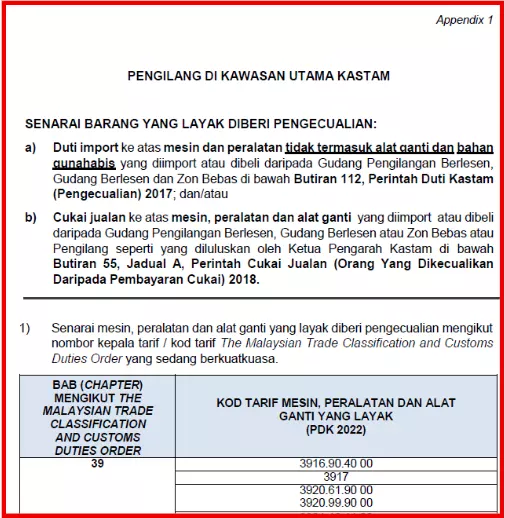
Source: Extract from Appendix 1, Guideline on Sales Tax Exemption under Items 33A, 33B, 55, 63, 64 and 65 of Schedule A to the Sales Tax (Persons Exempted from Payment of Tax) Order 2018 (as at 12 November 2025). - The goods must be new and unused.
- The goods must be used directly in manufacturing finished goods at the approved premises.
- The goods must remain at the approved premises, subject to Customs' requirements.
- The goods must be sourced through permitted channels:
- Imported goods;
- Purchases from a Licensed Manufacturing Warehouse (LMW), bonded warehouse or free zone; or
- Purchases from a manufacturer approved by the Director General of Customs.
How to Apply for Item 55 Exemption?
For manufacturers planning to claim the existing Item 55 exemption, the application process can be summarised into three main steps:
Step 1: Obtain MIDA Confirmation Letter (SPM)
Apply to MIDA for confirmation that the company qualifies as a manufacturer in the Principal Customs Area. The application can be made online through the MIDA online application portal.
Step 2: Apply for Sales Tax Exemption Certificate through MySST
Once the MIDA Confirmation Letter is obtained, apply online through the MySST portal. The company will need to provide the MIDA reference number and details of the machinery, equipment or spare parts applied for.
Step 3: Use the Exemption Certificate and Maintain Records
Once the exemption certificate is generated, the manufacturer should present the valid MIDA Confirmation Letter and exemption certificate when importing or purchasing the qualifying goods. The relevant invoices and import documents should be issued in the name of the approved company.
The manufacturer must also maintain proper records and submit the required Laporan CJ(P) Jadual A-MIDA to the relevant Customs station when purchases or importations under the exemption take place.
Important: The application should be planned before the importation or purchase. Manufacturers should also check the latest Customs guideline and approved tariff code list to ensure the goods qualify.
B. Schedule B – Approved Manufacturing Inputs
Schedule B provides sales tax exemption for specified goods used solely in the manufacture of certain products or goods, subject to the conditions under the relevant items. These include:
- Pharmaceutical products;
- Animal feed, fertilisers and pesticides;
- Controlled articles under the Control of Supplies Act 1961 [Act 122] that are subject to price control;
- Milk products falling under specified tariff headings and subheadings under the prevailing Customs Duties Order; and
- Exempted goods manufactured for export, covering qualifying raw materials, components, manufacturing aids, cleanroom equipment, and packing and packaging materials.
However, the exemption is not automatically available for all raw materials or manufacturing inputs. The eligible goods, intended use, manufacturer's eligibility and other applicable conditions must be checked against the relevant Schedule B item.
Important: Although Schedule B currently provides exemptions for a wider range of manufacturing activities, the Budget 2027 proposal specifically identifies manufacturing inputs for pharmaceutical products, animal feed, fertilisers and pesticides under the proposed refund facility. The proposal does not expressly include controlled articles, milk products or goods manufactured for export. Therefore, businesses should not assume that these categories will qualify for the new sales tax refund facility.
3. What Is New Under Budget 2027?
Budget 2027 proposes to introduce a sales tax refund facility for local traders or distributors who have paid sales tax on qualifying goods supplied to manufacturers.
The proposed facility covers:
- Machinery, equipment and spare parts under Item 55, Schedule A; and
- Approved manufacturing inputs under Schedule B for pharmaceutical products, animal feed, fertilisers and pesticides.
The proposed effective date is 1 January 2027.
One important point to understand is that the proposed refund is intended for the eligible trader or distributor who has paid the sales tax. It is not automatically a refund claim made directly by the manufacturer.
As the proposal is expected to take effect on 1 January 2027, businesses should look out for further announcements from the Royal Malaysian Customs Department on the detailed eligibility criteria, supporting documents, refund mechanism and application procedures.
4. Before vs After: How Does It Work?
The difference between the existing exemption and the proposed refund facility can be illustrated as follows:
Before vs After Budget 2027
| Before Budget 2027 | After Budget 2027 Proposal |
|---|---|
| Existing sales tax exemption facilities are available to qualifying manufacturers, subject to the relevant conditions and permitted purchasing channels. | A new Sales Tax Refund Facility is proposed to cover qualifying goods supplied to manufacturers through eligible local traders or distributors. |
| The existing Sales Tax Deduction facility provides partial tax relief to registered manufacturers purchasing qualifying manufacturing inputs from suppliers other than registered manufacturers, such as through retail or ad-hoc purchases. | Eligible local traders or distributors may claim a refund of sales tax paid on qualifying goods supplied to manufacturers, subject to further announcements and the relevant implementation requirements. |
| The existing facilities are subject to their respective eligibility requirements and conditions. | The proposal covers machinery, equipment and spare parts under Item 55, Schedule A, as well as specified manufacturing inputs under Schedule B for pharmaceutical products, animal feed, fertilisers and pesticides. |
| — | Proposed effective date: 1 January 2027. |
In simple terms, the proposal seeks to address the gap where manufacturers purchase qualifying goods through local traders or distributors instead of importing directly or purchasing through the existing eligible channels.
5. What Should Businesses Take Note Of?
Although the proposed facility is a positive development, businesses should start reviewing their procurement and documentation arrangements.
For manufacturers:
- Identify machinery, equipment, spare parts and manufacturing inputs that may qualify.
- Review whether purchases are made directly or through local traders and distributors.
- Discuss pricing arrangements with suppliers to understand whether any refund benefit will be reflected in the purchase price.
For traders and distributors:
- Identify qualifying goods supplied to manufacturers.
- Maintain proper purchase and sales invoices, together with evidence of sales tax paid.
- Keep records that can substantiate the onward supply to eligible manufacturers.
- Monitor the Customs announcement for the detailed refund application requirements.
Importantly, the proposed refund does not automatically guarantee a reduction in the manufacturer's purchase price. The actual commercial benefit will depend on the pricing and contractual arrangements between the trader or distributor and the manufacturer.
6. Conclusion
The proposed Sales Tax Refund Facility under Budget 2027 is a welcome development for manufacturers that rely on local traders and distributors to source machinery, equipment, spare parts and approved manufacturing inputs.
By addressing the gap in the existing exemption mechanism, the proposal could provide greater flexibility in procurement and support the local manufacturing supply chain.
Nevertheless, businesses should take note that this remains a Budget 2027 proposal. The proposal is still subject to further legislation and Customs guidance, particularly on eligibility, supporting documents and refund procedures.
For now, manufacturers and local traders should review their existing procurement arrangements and prepare to assess the impact once the detailed rules are issued.
Contact YYC today to find out how we can support your tax compliance and advisory needs.
Disclaimer: This article is based on the Budget 2027 tax measures and publicly available guidance as at the date of publication. The proposed facility is subject to relevant legislation and further guidance from the authorities. Readers should refer to the latest official publications before making any tax decisions