e-Invoice
Malaysia: RM3 Million Exemption – Can You Stop e-Invoice? 15 FAQs Answered
Publish: 7 September 2026
Your one-stop guide to Malaysia's new e-Invoice RM3 million exemption, covering eligibility, effective dates, August 2026 transactions, related-company rules, voluntary participation, SVDP and available tax incentives.
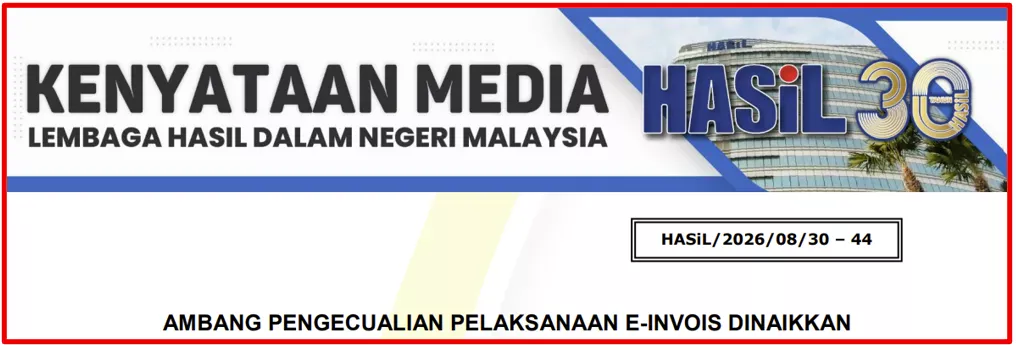
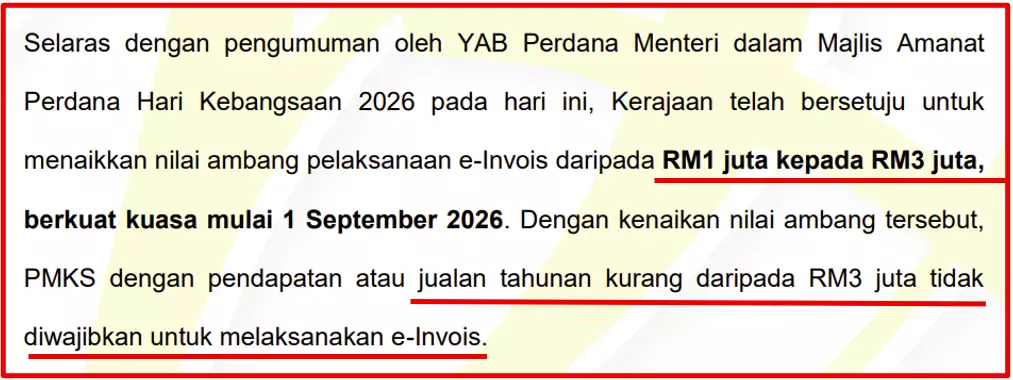
Prime Minister Datuk Seri Anwar Ibrahim announced on 30 August 2026 that the Government had agreed to increase the e-Invoice exemption threshold from RM1 million to RM3 million.
Following the announcement, the Inland Revenue Board of Malaysia (IRB/LHDN), also known as HASiL, issued a media release on the same day, confirming that the e-Invoice exemption threshold would be increased to RM3 million, in line with the Prime Minister’s announcement. According to HASiL, taxpayers with annual turnover or revenue of less than RM3 million are not required to implement e-Invoice, subject to the applicable exemption criteria.
HASiL also highlighted that the increased threshold is expected to benefit more than 1.1 million businesses, reducing the compliance burden and costs for micro, small and medium enterprises (MSMEs).
At the same time, the Government continues to encourage eligible MSMEs to participate in e-Invoice voluntarily as part of the country's business digitalisation initiative.
But does this mean you can simply stop e-Invoice? Not necessarily.
Not sure whether your business can stop issuing e-Invoices? These 15 frequently asked questions cover the key issues businesses should consider following the increase of the e-Invoice exemption threshold to RM3 million.
- Who is eligible for the RM3 million e-Invoice exemption?
- Is the RM3 million threshold based on the calendar year or the company's financial year?
- When does the new RM3 million e-Invoice exemption take effect?
- If my turnover is below RM3 million, can I stop issuing e-Invoices immediately?
- Do I still need issue consolidated e-Invoice for August transaction by 7 September 2026 and e-Invoice for foreign income?
- Does self-billed e-Invoice requirement still applies if the customs clearance trigger point occurred before 1 September 2026?
- Do I need to notify LHDN if I stop e-Invoice?
- What if my accounting system has already automatically submitted e-Invoices, what should we do if we are now eligible for the exemption?
- If my turnover was previously above the applicable threshold but is now below RM3 million, but I have not implemented e-Invoice, can I now rely on the RM3 million exemption?
- If my turnover is below RM3 million but I mistakenly started issuing e-Invoices, can I subsequently stop?
- Is the RM3 million threshold determined separately for each company within a group?
- Can one company in a group continue e-Invoice voluntarily while another related company stops?
- If the holding company is below RM3 million but its subsidiary exceeds RM3 million, does the holding company remain exempt?
- If a company's turnover subsequently exceeds RM3 million, when will it be required to implement e-Invoice?
- Can I still claim tax incentives for e-Invoice implementation if I cease e-Invoice?
Frequently
Asked Questions About the RM3 Million e-Invoice Exemption
Section
1 - Eligibility for the RM3 Million Threshold
1.
Who is eligible for the
RM3 million e-Invoice exemption?
The exemption applies to all category of taxpayers with annual turnover or revenue of less than RM3 million. However, qualifying the RM3 million exemption threshold alone does not automatically mean that the taxpayer is exempt from implementing e-Invoice. Taxpayers should also review the other exemption criteria before deciding whether they can cease e-Invoice.
Exemption criteria
The exemption does not apply if the taxpayer:
a) has non-individual shareholder(s) (or equivalent)
with annual turnover or revenue of at least RM3 million; or
b) is a subsidiary of a holding company with annual
turnover or revenue of at least RM3 million; or
c) has related company* / joint venture with annual
turnover or revenue of at least RM3 million.
* Related company for e-Invoice purposes includes the following scenarios:
a) Common corporate shareholder / control
i. Where the operations of the companies can be controlled,
either directly or indirectly, by another company, the companies are
considered related companies for e-Invoice purposes.
ii. Where a company holding at least 20%
of the issued share capital in another company, the two companies are
considered related companies for e-Invoice purposes.
2. Is the RM3 million threshold based on the calendar year or the company's financial year?
The determination is based on the relevant financial year / year of assessment, rather than simply the calendar year.
a) Taxpayers with audited financial statements: Based on annual turnover or revenue stated in the Statement of Comprehensive Income in the relevant audited financial statements;
b) Taxpayers without audited financial statements: Based on annual revenue reported in the relevant income tax return for year of assessment relevant year; or
c) Taxpayers with annual turnover or revenue of at least RM3 million for the relevant year.
Section 2 - Effective Date of the New Exemption
3. When does the new RM3 million e-Invoice exemption take effect?
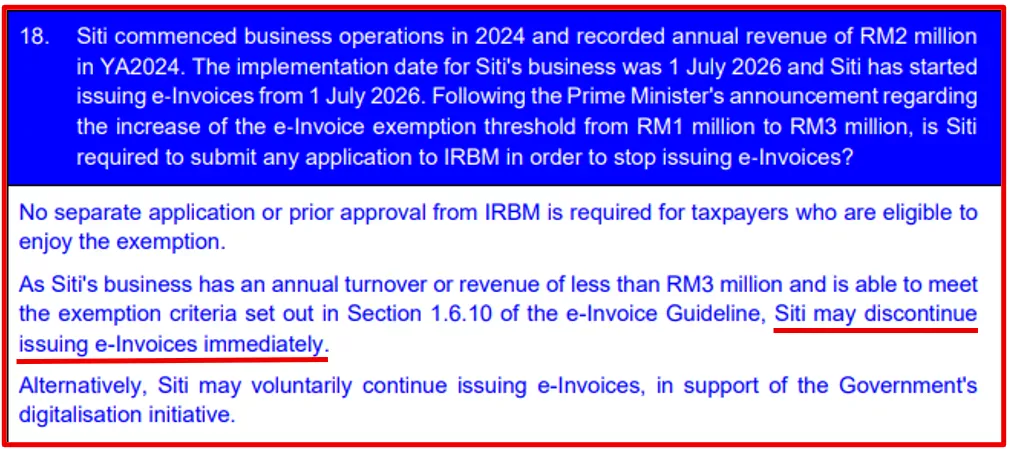
The increased e-Invoice exemption threshold of RM3 million takes effect immediately after the announcement.
Source: HASiL – FAQ 18 of e-Invoice General Frequently Asked Questions (FAQs)
4. If my turnover is below RM3 million, can I stop issuing e-Invoices immediately?
Yes, if the taxpayer qualifies for the exemption under the new RM3 million threshold and satisfies all applicable exemption criteria.
Exemption criteria
The exemption applies only if the taxpayer:
a) has no non-individual shareholder(s) (or equivalent) with annual turnover or revenue of at least RM3 million; or
b) is not a subsidiary of a holding company with annual turnover or revenue of at least RM3 million; or
c) has no related company / joint venture with annual turnover or revenue of at least RM3 million.
5. Do I still need issue consolidated e-Invoice for August transaction by 7 September 2026 and e-Invoice for foreign income?
No, if the taxpayer is eligible for the RM3 million exemption, they may discontinue issuing e-Invoices immediately.
6. Does self-billed e-Invoice requirement still applies if the customs clearance trigger point occurred before 1 September 2026?
No, if the taxpayer is eligible for the RM3 million exemption, they may discontinue issuing e-Invoices immediately.
Section 3 - Businesses That Have Already Implemented
e-Invoice
7. Do I need to notify LHDN if I stop e-Invoice?
Based on the current arrangement, there is no specific application or approval from HASiL is required for an eligible taxpayer to cease issuing e-Invoices. The eligible may discontinue issuing e-Invoices immediately after the announcement, subject to satisfying all applicable exemption criteria.
Nevertheless, taxpayers should maintain proper documentation to support their eligibility for the exemption.
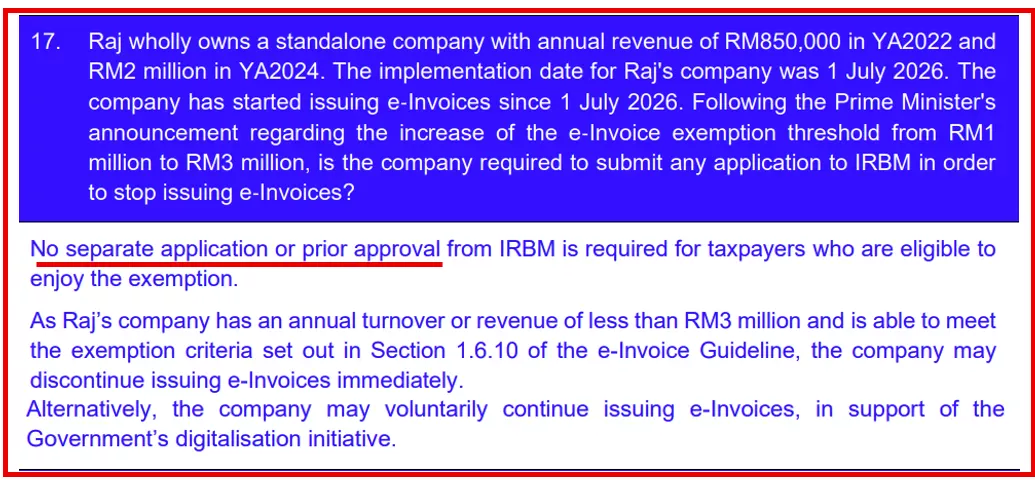
Source: HASiL – FAQ 17 of e-Invoice General Frequently Asked Questions (FAQs)
8. What if my accounting system has already automatically submitted e-Invoices, what should we do if we are now eligible for the exemption?
If the taxpayer is eligible for the exemption, the taxpayer should update or reconfigure the accounting/e-Invoice system accordingly to prevent further e-Invoices from being issued or submitted unnecessarily.
Section 4 - Businesses That Did Not Implement e-Invoice
9. If my turnover was previously above the applicable threshold but is now below RM3 million, but I have not implemented e-Invoice, can I now rely on the RM3 million exemption?
Based on the e-Invoice General Frequently Asked Questions (FAQs) dated 4 September 2026, taxpayers with an annual turnover or revenue of less than RM3 million and are able to meet the exemption criteria are exempt from implementing e-Invoice.
No e-Invoice compliance actions or penalty will be imposed in this case. In additional, the taxpayer is not required to participate in the e-Invoice Special Voluntary Disclosure Programme (SVDP).
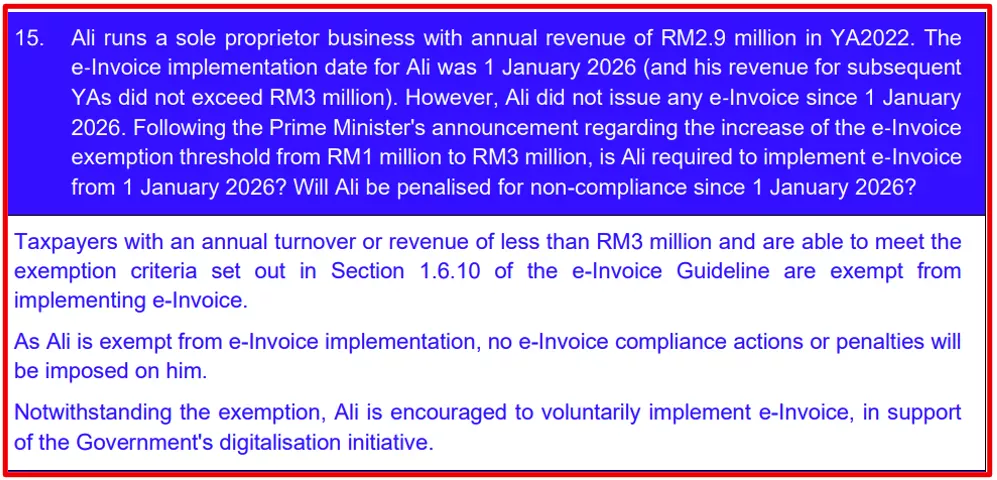
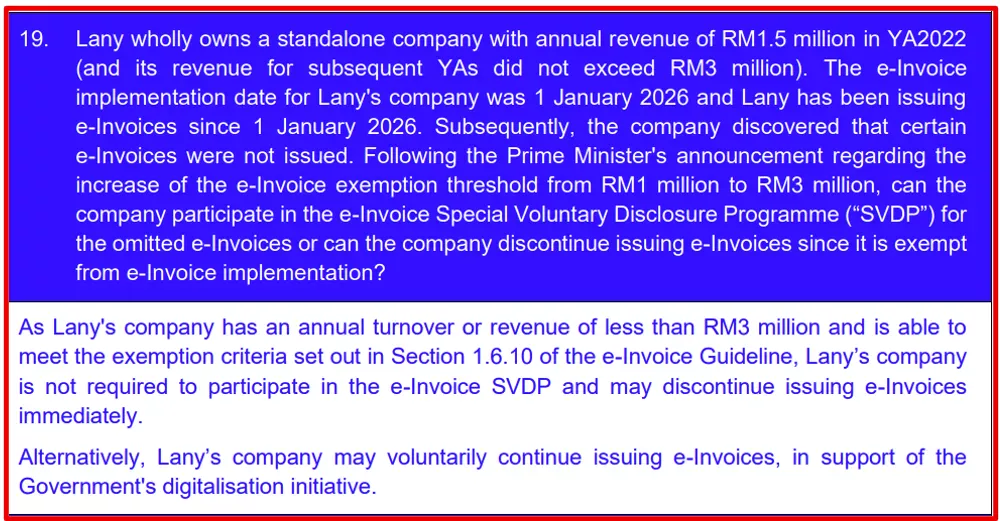
Source: HASiL – FAQ 15 & FAQ 19 of e-Invoice General Frequently Asked Questions (FAQs)
10. If my turnover is below RM3 million but I mistakenly started issuing e-Invoices, can I subsequently stop?
Yes, provided the taxpayer qualifies for the exemption and satisfies all applicable exemption criteria.
Section 5 - Group / Related Companies
11. Is the RM3 million threshold determined separately for each company within a group?
The threshold should be assessed separately for each company or each taxpayer, but taxpayers must also consider the specific exemption criteria relating to non-individual shareholders, holding companies, related companies and joint ventures.
Therefore, being below RM3 million does not automatically mean that every company within a group is exempt.
12. Can one company in a group continue e-Invoice voluntarily while another related company stops?
Yes, one company may voluntarily continue issuing e-Invoices while another eligible company chooses not to stop issuing e-Invoice.
13. If the holding company is below RM3 million but its subsidiary exceeds RM3 million, does the holding company remain exempt?
The holding company does not qualify for the exemption due to its related company having annual turnover or revenue of at least RM3 million.
The group structure and relevant turnover should therefore be reviewed before determining the exemption.
Section 6 - Future Changes in Turnover
14. If a company's turnover subsequently exceeds RM3 million, when will it be required to implement e-Invoice?
Where
the specific exemption criteria are being met and annual turnover or revenue
reaches or exceeds RM3 million in YA 2026 or subsequent years, the
taxpayer is required to implement e-Invoice starting from 1 January in the
second year following the YA in which the total annual turnover or revenue
reaches RM3 million.
Example: If the company reaches RM3 million in YA 2027, the implementation
date would be 1 January 2029.
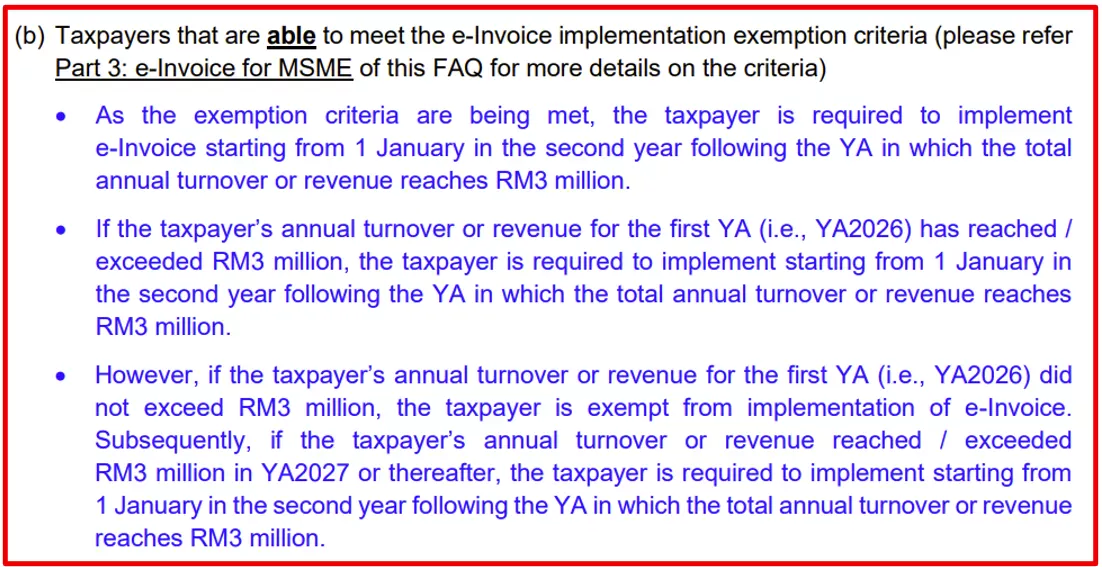
Source: HASiL – FAQ 14(b) of e-Invoice General Frequently Asked Questions
Section 7 – Tax Incentives
15. Can I still claim tax incentives for e-Invoice implementation if I cease e-Invoice?
Yes. You may still claim the qualifying expenditure (QE) incurred for ICT equipment and customised computer software used for e-Invoice implementation, provided the relevant requirements and conditions are satisfied.
However, the tax treatment depends on the nature of the expenditure, the particular incentive being claimed and whether the specific qualifying conditions are satisfied.
The Government has introduced several tax measures relating to e-Invoice implementation, including accelerated capital allowance (ACA) for qualifying ICT equipment and customised computer software, as well as an ESG-related tax deduction for certain e-Invoice implementation expenditure incurred by qualifying MSMEs.
It is important to distinguish between these measures, as their qualifying expenditure and conditions are not the same.
Comparison of the available tax measures:
| Tax measure | Qualifying expenditure | Rate / limit | YA | Key conditions |
|---|---|---|---|---|
| ACA – ICT equipment and computer software for e-Invoice P.U. (A) 162/2026 |
Qualifying expenditure incurred on ICT equipment and computer software used for e-Invoice implementation | IA 20% + AA 40% | YA 2024–2027 | Taxpayer must comply with the prescribed e-Invoice implementation timeline and must not have been granted flexibility/relaxation for e-Invoice issuance, and subject to the other conditions under P.U. (A) 162/2026 |
| ACA – Customised computer software for e-Invoice P.U. (A) 163/2026 |
Development cost of customised computer software, including consultation fees, payment for software ownership rights and incidental fees relating to development | IA 20% + AA 40% | YA 2024–2027 | Taxpayer must comply with the prescribed e-Invoice implementation timeline and must not have been granted flexibility/relaxation for e-Invoice issuance, and subject to the other conditions under P.U. (A) 163/2026 |
| ACA – Full claim within 1 year (Media release by LHDN dated 7 July 2026, Pending issuance of gazette order) |
Expenditure on ICT equipment and computer software packages as well as development cost for customised computer software used for e-Invoice implementation | 100% capital allowance within 1 year | Pending issuance of gazette order | Available as an appreciation/incentive for taxpayers who fully comply with the e-Invoice implementation timeline without utilising the interim relaxation period. |
| ESG tax deduction – e-Invoice P.U. (A) 193/2025 |
For qualifying MSMEs: consultation fees for development of customised software and services of external service providers relating to e-Invoice implementation | Up to RM50,000 for each YA | YA 2024–2027 | Subject to the eligibility and other conditions under the ESG Rules P.U. (A) 193/2025. Certain costs are specifically excluded. |
Important: Taxpayers should not assume that ceasing e-Invoice automatically preserves or disqualifies a tax incentive. The qualifying expenditure and conditions under the relevant legislation should be reviewed separately.
Key Takeaway
Can
you stop e-Invoice?
If your annual turnover or revenue is below RM3 million, the answer may be yes, but don't stop based on the RM3 million threshold alone.
First, check whether you satisfy all applicable exemption criteria.
Need
Help with Your e-Invoice Requirements?
Not sure whether your business qualifies for the RM3 million e-Invoice exemption? Wondering whether you can stop issuing e-Invoices or whether your business is still eligible for e-Invoice-related tax incentives?
Don't leave your e-Invoice compliance to guesswork.
Our tax professionals at YYC can help you assess your business's e-Invoice position, understand the applicable requirements and provide practical guidance based on your specific circumstances.
Whether you need e-Invoice consultation, compliance assistance, implementation support or clarification on any e-Invoice-related or taxation matters, we're here to help.
👉 Contact YYC today to speak with our tax professionals or submit your enquiry.