Budget
2027 Malaysia: Individual Tax Reliefs, Rates and What Changes (YA 2027)
Publish: 16 October 2026
Budget 2027 was tabled on 9 October 2026, and for most of us the questions are simple: Is there a tax “sweetener” this time? What can I claim? Are there any new taxes? The short answer is that this is a budget with good news for individual taxpayers, especially the middle-income group. The personal relief goes up for the first time since 2010, two tax bands get a one percentage point cut, and several reliefs have been widened to match how people actually live today, from AI subscriptions to postnatal care. On the individual income tax side, the main increase is at the top end: the 30% rate now starts at RM1 million of chargeable income.
This guide walks through every Budget 2027 measure that affects individual income tax. For each one, we show what the rule is today, what changes, and the conditions you need to meet to claim. We have also added worked examples, a claim checklist and a short list of other measures that touch individuals.
Budget
2027 individual tax measures at a glance
| Measure | Today | Budget 2027 (YA 2027) | Effective from |
|---|---|---|---|
| Personal and dependent relatives relief | RM9,000 | RM12,000 | YA 2027 |
| Tax rate Chargeable income RM70,001 to RM100,000 |
19% | 18% | YA 2027 |
| Tax rate Chargeable income RM100,001 to RM150,000 (new band) |
25% | 24% | YA 2027 |
| Tax rate Chargeable income RM1,000,001 to RM2,000,000 |
28% | 30% | YA 2027 |
| Medical treatment relief | RM10,000 cap | RM10,000 cap, renamed Health and Well-being, adds postnatal care (RM3,000) and breastfeeding equipment (RM1,000) now claimable by self or spouse | YA 2027 |
| Parents and grandparents relief | RM8,000 cap; certain care services supported by medical practitioner verification | Covers all care expenses, no practitioner verification for care. No change to the cap was announced | YA 2027 |
| Sports-related lifestyle relief | RM1,000 | RM1,000, with sports shoes allowed up to RM300 | YA 2027 |
| Education fees and skills | RM7,000 with RM2,000 upskilling relief until YA 2026 | Reclassified as Education and Skills Training Fees, RM7,000 cap, wider scope | YA 2027 |
| Lifestyle relief | RM2,500 | RM2,500, adds AI software subscriptions and pet care | YA 2027 |
| SOCSO relief | RM350 | RM350, plus up to RM150 for voluntary contributions | YA 2027 |
| Tourism relief | RM1,000 for YA 2026 | Extended to YA 2027 | YA 2027 (one-year extension) |
| Equity crowdfunding and angel investor tax exemption | For investments made until 31 December 2026 | Extended to investments made until 31 December 2030 | Investments made 1 Jan 2027 to 31 Dec 2030 |
| First home stamp duty exemption | 100% exemption for homes up to RM500,000 | Also covers homes up to RM750,000 (100% on the first RM500,000, 50% on the balance), for agreements signed 2027 to 2030 | Agreements signed 1 Jan 2027 to 31 Dec 2030 |
When do
these changes apply?
All the individual tax measures above take effect from YA 2027, meaning income earned from 1 January to 31 December 2027, with the tax return filed in 2028. Nothing here changes how you file your YA 2026 return in 2027, with one happy exception: the tourism relief is still available for YA 2026 expenses.
A quick note on status. These are Budget proposals. They become law once the relevant legislation is passed and gazetted, and the Inland Revenue Board (LHDN) will issue detailed guidelines. We will update this article when that happens.
1. Higher
personal relief: RM9,000 to RM12,000
What it is. Every resident individual with income gets a relief for themselves and dependent relatives. It has been RM9,000 since 2010.
What changes. It rises to RM12,000, a RM3,000 increase, from YA 2027.
Conditions. This is an automatic relief for individuals who are tax residents in Malaysia, assessed in their own name. There is no receipt to keep and no separate claim to make beyond filing your return.
What it means in practice. At 25% income tax rate, an extra RM3,000 relief is worth RM750 in tax. At 11% tax rate, it is worth RM330. The higher your income tax rate, the more it saves.
2. New
income tax rates for residents
This is where the headline saving comes from. The government has restructured the bands so that the middle-income group pays less, while the very highest earners pay more.
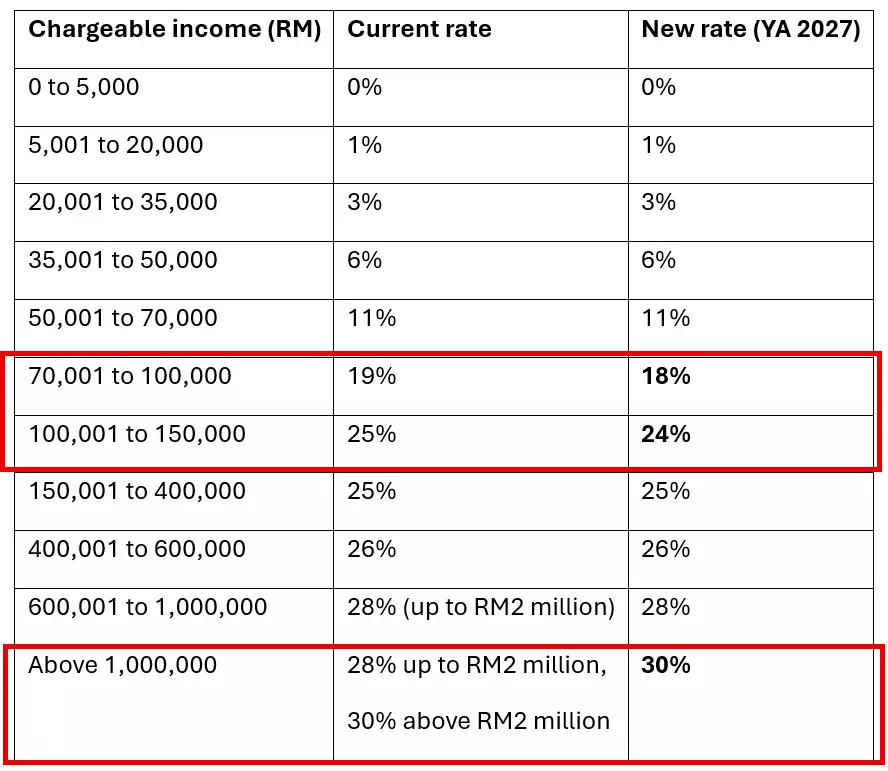
Three
things to notice.
- The cuts apply to the slice of income in each band, not your whole income. Someone earning RM120,000 chargeable income benefits from 1 percentage off the RM70,001 to RM100,000 slice and 1 percentage off the RM100,001 to RM120,000 slice.
- The RM100,001 to RM150,000 band is new. Previously, everything from RM100,001 to RM400,000 was taxed at 25%.
- If your chargeable income exceeds RM1 million, the 30% rate now applies to the portion above RM1 million. Before, it only applied above RM2 million.
3. Health
and Well-being relief (including postnatal care)
The existing medical treatment relief is renamed Health and Well-being. The overall cap stays at RM10,000, but the scope is wider.
What is
covered
| Expense | Sub-limit | Who it is for |
|---|---|---|
| Serious illness treatment | Within RM10,000 | Self, spouse, child |
| Fertility treatment | Within RM10,000 | Self or spouse (married individuals only) |
| Vaccinations | RM1,000 | Self, spouse, child |
| Dental examination and treatment | RM1,000 | Self, spouse, child |
| Complete medical examination, mental health examination or consultation, disease detection tests, self-testing medical devices | RM1,000 | Self, spouse, child |
| Assessment, early intervention or rehabilitation for children with learning disabilities (aged 18 and below) | Within RM10,000 | Child |
| New: Postnatal care services from a confinement centre or qualified individual | RM3,000 | (Written guidelines pending) |
| Breastfeeding equipment for children aged 2 and below (merged into this relief) | RM1,000 | Self or spouse |
Conditions
to claim (current LHDN rules, expected to continue)
- Serious illness and fertility treatment must be supported by a receipt and certification from a medical practitioner registered with the Malaysian Medical Council.
- Dental treatment must be supported by a receipt and a certificate from a dental practitioner registered with the Malaysian Dental Council.
- Serious diseases are those listed in LHDN guidelines, such as AIDS, Parkinson's disease, cancer, renal failure, heart attack, pulmonary hypertension, chronic liver disease, fulminant viral hepatitis, head trauma with neurological deficit, tumor in brain or vascular malformation, major burns, major organ transplant, major amputation of limbs, Chronic Skin Disease, Mental Illness, Endocrine Disease, Rheumatology, and Tallasemia Major.
- Vaccinations: from YA2026, that qualify include any vaccination of a vaccine registered with the National Pharmaceutical Regulatory Agency.
- A complete medical examination means a full check-up as defined by the Malaysian Medical Council, with a discussion of the results with the doctor.
- Keep every receipt. Claims must be backed by official receipts.
What is
new
- Postnatal care is a new category, capped at RM3,000, for services provided by a confinement centre or a qualified individual.
- Breastfeeding equipment used to be its own relief of RM1,000. Under the current rules it is for working mothers only, for their own use, for children up to age 2, and claimable once every two years. Under the proposal it moves into the Health and Well-being relief, can be paid by the mother or her spouse, and is claimable every year from YA 2027, with no limit on the number of children.
A point to watch. Because breastfeeding equipment is being merged into the RM10,000 limit, parents who already use up the full RM10,000 will no longer get that extra RM1,000.
LHDN's Budget 2027 seminar slides set out the change as follows.
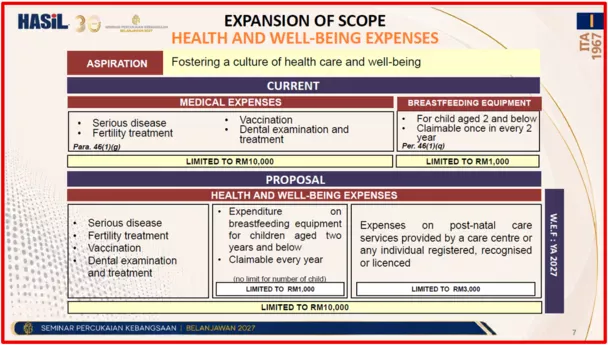
Source: LHDN Budget 2027 tax seminar slides.
4.
Broader relief for the care of parents and grandparents
This relief has the biggest change in spirit. It used to be about medical care. It is now about care in general.
Today (YA
2025 and YA 2026)
A relief of up to RM8,000 covers expenses for parents and grandparents on:
- Medical treatment at clinics and hospitals.
- Treatment and care at home, day care centres and residential care centres.
- Dental treatment (cosmetic dental work excluded).
- A full medical examination and vaccinations, limited to RM1,000.
A registered medical practitioner currently has to verify the health condition of the parent or grandparent who needs care.
Budget
2027 change
Expenses for the care of parents and grandparents at home, day care centres and residential care centres will cover all types of care expenses, not just health or medical care. You will no longer need verification from a registered medical practitioner for these care claims. Instead, you retain:
- A written declaration from the carer, or a copy of the carer's work permit, plus
- Receipts.
LHDN's Budget 2027 seminar slides summarise the change in documents as follows.
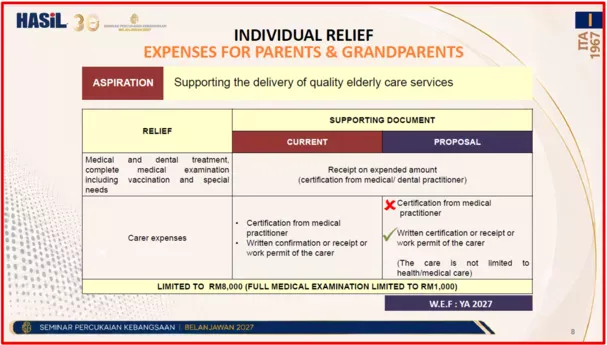
Source: LHDN Budget 2027 tax seminar slides.
The slide lists the carer documents as alternatives, while the Budget appendix pairs the carer's declaration or work permit with receipts. Until LHDN issues its guidelines, the safe approach is to keep all of them.
Conditions
that apply
- Parents are natural parents or foster parents. Grandparents are your parents' parents.
- Your parents or grandparents must be Malaysian tax residents.
- Treatment, examination and care must be provided in Malaysia.
- Medical and dental practitioners must be registered with the Malaysian Medical Council or the Malaysian Dental Council.
- The carer cannot be you, your spouse or your child.
- Foreign carers must hold a valid visa or special work permit.
What to confirm. The announcement does not change the RM8,000 limit. LHDN's final guidelines should clarify how far the wider care scope goes, for example whether care for parents who are otherwise healthy qualifies. Under today's rules, a carer's salary for physically and mentally healthy parents does not qualify.
5.
Sports-related lifestyle relief: sports shoes now included
Today. A relief of up to RM1,000 is given for sports activities listed under the Sports Development Act 1997, covering:
- Sports equipment (excluding motorised two-wheel bicycles).
- Rental or entrance fees to sports facilities.
- Registration fees for sports competitions run by organisers approved and licensed by the Commissioner of Sports.
- Gym membership or sports training fees charged by clubs or societies registered with the Commissioner of Sports, or companies incorporated under the Companies Act 2016 to carry out listed sports.
What changes. Sports shoes are added, limited to RM300 within the same RM1,000 cap.
Conditions.
- The expense can be for yourself, your spouse, your child or your parents.
- Parents must be Malaysian tax residents.
- Each purchase or payment must be backed by a receipt.
Local, overseas, online or in-store? Neither the Budget 2027 say where sports equipment must be bought. The ruling only requires that each purchase is backed by a payment receipt, and that the expense is for you, or in your name, or for your spouse, child or parents. So as the rules stand, no restriction on local, overseas, online or in-store purchases is stated. For online or overseas orders, keep the order invoice and proof of payment in your name. Since LHDN has not yet addressed sports shoes specifically, check its final guidelines before claiming an overseas purchase.
6.
Education and Skills Training Fees relief (reclassified)
This relief is reorganised and broadened. The old RM7,000 education fees relief and the RM2,500 lifestyle element for self-enrichment courses are merged into one relief called Education and Skills Training Fees, with an overall limit of RM7,000.
Today
- Up to RM7,000 for fees paid for courses up to degree level in specified fields (law, accounting, Islamic finance, technical, vocational, industrial, scientific or technology), or for Master's or PhD studies, at recognised local institutions or professional bodies.
- A separate RM2,000 for upskilling courses recognised by the Director General of Skills Development. This relief runs only until YA 2026.
- Under lifestyle relief, up to RM2,500 shared with other lifestyle items for self-enrichment courses unrelated to your job.
Budget
2027 structure (all within the RM7,000 cap)
| Category | Limit | Who it is for |
|---|---|---|
| Courses or studies at Certificate, Diploma, Bachelor's, Master's or PhD level in any field, recognised by a regulatory agency, at a local institution or professional body recognised by the Government or approved by the Minister of Finance | Within RM7,000 | Self |
| Upskilling or self-enhancement courses in Technical and Vocational Education and Training (TVET) recognised by the Director General of Skills Development | RM3,000 | Self or spouse |
| a. Courses, training and skills classes unrelated to employment; or b. Courses, training, classes or tuition in Science, Technology, Engineering and Mathematics (STEM), arts, languages and religion |
Combined limit RM2,000 | Self, spouse or children |
Conditions
- Institutions must be local and recognised by the Government or approved by the Minister of Finance.
- TVET courses must be recognised by the Department of Skills Development under the National Skills Development Act 2006.
- Keep fee receipts. For Islamic finance studies, courses must be approved by Bank Negara Malaysia or the Securities Commission.
7.
Lifestyle relief: AI subscriptions and pet care
The lifestyle relief limit stays at RM2,500, but two new categories are added.
What the
RM2,500 covers today
- Books, journals, magazines, newspapers and similar publications, including e-books.
- A personal computer, smartphone or tablet for personal use (not for your own business). Warranty charges do not qualify.
- Monthly internet subscription bills registered in your name or used by your spouse or child.
New from
YA 2027
- Subscriptions for AI software and applications for personal use, or for your spouse or child.
- Pet adoption cost from registered animal shelters.
- Registered veterinary services for vaccination and spaying or neutering.
Conditions. Expenses must be backed by receipts. The government's stated aim is to encourage digital literacy and compassion towards animals.
What is not mentioned. Pet food, grooming and general veterinary care are not listed in the proposal. Self-enrichment courses (unrelated to employment) leave the lifestyle relief and move to Education and Skills Training Fees.
Tip. The RM2,500 cap is shared across all of these items, so a family with an internet bill, a laptop and an AI subscription may reach it quickly. Prioritise claims in the order that benefits you most, and keep documents for all of them.
8.
Expanded SOCSO contribution relief
Today. Private sector employees can claim up to RM350 for contributions under the Employees' Social Security Act 1969 and the Employment Insurance System Act 2017.
What
changes
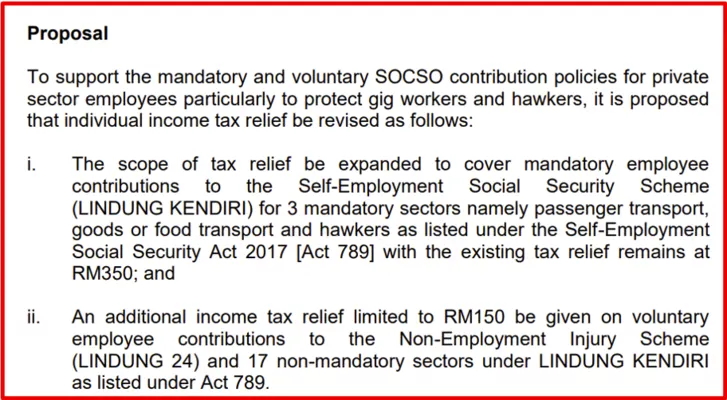
- Mandatory Lindung Kendiri contributions (Self-Employment Social Security Scheme) now qualify within the existing RM350. This covers three mandatory sectors: passenger transport, goods or food transport, and hawkers, as listed in the Self-Employment Social Security Act 2017.
- An additional RM150 relief is given for voluntary contributions to Lindung 24 Jam and to the 17 non-mandatory sectors under Lindung Kendiri.
In practice, someone with both mandatory and voluntary contributions could claim up to RM500 in total. The measure is aimed at gig workers, e-hailing and p-hailing drivers, and hawkers.
Budget 2027 tax measures appendix set out the change as follows.
Conditions. You must have actually contributed in the basis year.
9.
Tourism relief extended to YA 2027
Today. For YA 2026, individuals can claim up to RM1,000 for entrance fees to:
- Tourist attractions such as museums, zoos, theme parks, national parks, marine parks and geoparks.
- Cultural and arts programmes.
What changes. The relief is extended by one year, to YA 2027, in line with Visit Malaysia Year 2026, which extends into 2027.
Conditions. Keep tickets and receipts for the entrance fees. As this is an extension of an existing relief, LHDN's current guidance on eligible attractions should continue to apply.
10. Equity
crowdfunding and angel investor exemption extended to 2030
Two exemptions for individuals who invest in start-ups are extended for four years, to investments made from 1 January 2027 until 31 December 2030. Both currently apply to investments made until 31 December 2026.
| Item | Equity crowdfunding (ECF) | Angel investor |
|---|---|---|
| Exemption | 50% of the amount invested. The exemption is given in the second year of assessment after the year you invest. | 100% of the amount invested. The exemption is given in the second year of assessment after the year you invest. |
| Limits | Exempt amount capped at RM50,000 a year and 10% of aggregate income | Investment of RM5,000 to RM500,000 a year; exemption capped at your aggregate income |
| Excess | Disregarded | Disregarded, not refunded or carried forward |
| Approval | Investor, investee company and amount verified by the Securities Commission; platform approved by the Securities Commission | Accredited by MBAN; investee certified by ATIO; investment approved by the Minister of Finance |
| Holding period | At least 2 years | At least 2 years |
| Other conditions | No family ties with the investee company | Resident individual with income not solely from business; no family ties; no more than 30% of the investee's paid-up share capital; investee is a Malaysian start-up at least 51% owned by Malaysian citizens |
If you invest in 2027, it applies to YA 2029, provided you keep the shares for two years.
Source: LHDN Public Ruling 12/2020, Income Tax (Exemption) (No. 4) Order 2022 [PU(A)142/2022] and the Budget 2027 tax measures appendix.
11. First
home stamp duty exemption widened to RM750,000
This is stamp duty, not income tax, but it directly affects first-home buyers. The price ceiling for the exemption rises from RM500,000 to RM750,000.
| Home price | Stamp duty exemption |
|---|---|
| Up to RM500,000 (same as today) | 100% on the loan agreement and instrument of transfer |
| New: RM500,001 to RM750,000 | 100% on the first RM500,000, and 50% on the balance |
Who and when. Malaysian citizens buying their first residential home, under sale and purchase agreements signed from 1 January 2027 to 31 December 2030. Today's exemption covers agreements signed until 31 December 2027.
What counts as a first home. You must never have owned any residential property, including one obtained by inheritance or gift, whether held individually or jointly.
Worked
examples: what does Budget 2027 mean for your tax?
The examples below compare tax under today's rules with tax under the new rules, for the same income. Each assumes a resident individual and that the extra RM3,000 personal relief reduces chargeable income. They exclude tax rebates, zakat and other adjustments, so treat them as illustrations and not advice.
| Chargeable income today (RM) | Tax today (RM) | Chargeable income after RM3,000 extra relief (RM) | Tax under new rates (RM) | Tax saved (RM) |
|---|---|---|---|---|
| 40,000 | 900 | 37,000 | 720 | 180 |
| 60,000 | 2,600 | 57,000 | 2,270 | 330 |
| 80,000 | 5,600 | 77,000 | 4,960 | 640 |
| 100,000 | 9,400 | 97,000 | 8,560 | 840 |
| 120,000 | 14,400 | 117,000 | 13,180 | 1,220 |
| 150,000 | 21,900 | 147,000 | 20,380 | 1,520 |
| 200,000 | 34,400 | 197,000 | 32,850 | 1,550 |
| 1,500,000 | 388,400 | 1,497,000 | 396,700 | -8,300 (pay more) |
Two key patterns stand out. Tax savings increase as chargeable income rises to around RM150,000, then level off at approximately RM1,550 because the proposed rate cuts only apply to income bands up to RM150,000. However, for high-income earners, the lower threshold for the 30% tax rate could offset these savings and potentially lead to higher overall tax payable.
The additional reliefs, such as postnatal care, AI subscriptions or the SOCSO top-up, are on top of this. Each RM1,000 of newly claimable expense saves about RM250 in tax for someone in the 25% band.
Claim
checklist: get ready now
- Keep every receipt, in hardcopy or digital form where possible. Every relief above is evidence-based except the personal relief.
- Separate expenses by category from 1 January 2027, so you can see where you are against each cap.
- Check recipients. Many reliefs depend on whether the expense is for yourself, your spouse, your child or your parents, and parents must be tax residents.
- Get the paperwork for care. If you support parents or grandparents, collect the carer declaration or work permit copy, and receipts from care centres.
- Review your PCB. Ask your employer whether monthly tax deductions will be updated for 2027, and review your PCB once LHDN announces the details.
- Don't forget YA 2026. The tourism relief and the RM2,000 upskilling relief are still claimable for expenses incurred in 2026.
Other
Budget 2027 measures that affect individuals
Other tax measures that may affect you.
- School Public Contribution Fund (TSUWAS). The scope of the fund is widened to cover administrative, operating and repair costs. Individual donors can still claim a deduction of up to 10% of aggregate income for cash contributions.
- Savings and current accounts. Stamp duty on the instruments for opening these accounts that contain an undertaking which creates a specific legal obligation, indemnity, guarantee or liability is exempted from 1 January 2027.
- Elderly care services. Service tax is cut from 8% to 6%, and providers registered under the relevant Acts are exempt on annual care fees of up to RM96,000 per person. This ties in neatly with the wider parents' care relief.
- PTPTN employer repayments. Employers who repay PTPTN loans on behalf of full-time employees can claim a tax deduction for repayments from 2027 to 2028, subject to conditions.
Frequently
asked questions
Will my
tax go down in 2027 under Budget 2027?
For most resident individuals with chargeable income up to about RM1 million, yes. The higher personal relief lowers your chargeable income, and the new rates reduce tax on the RM70,001 to RM150,000 slice. Those with chargeable income above RM1 million may pay more because the 30% rate now starts earlier.
Do I need
receipts for the new AI subscription relief?
Yes. Lifestyle relief claims must be supported by invoices or receipts.
Can I
claim pet food or grooming under lifestyle relief?
Based on the Budget 2027 proposal, no. The new scope covers pet adoption from registered animal shelters and registered veterinary services for vaccination and spaying or neutering.
Is the
tourism relief really still available?
Yes. Entrance fees up to RM1,000 can be claimed for YA 2026, and the relief is extended to YA 2027.
How YYC
can help
Tax reliefs only work when they are planned for and properly documented. At YYC, we help individuals, families, professionals and business owners across Malaysia make sense of tax changes, structure remuneration, and prepare tax returns with confidence. If you would like a personal review of what Budget 2027 means for you, speak to our team.
Contact YYC today to arrange a personal tax review.